The Frontier Firm Bet
A Decision-Maker’s Case for Microsoft AI, Fabric, Foundry, and M365 — Better Together with Databricks, Snowflake via OneLake, Delta and Iceberg
For architects designing the estate. For executives funding it. For both, the same conclusion.
The slow adopter problem is no longer subtle. Microsoft’s own Frontier Firm research shows organizations that move decisively on AI, agents, and a unified data estate are reporting outcomes roughly four times higher than slow adopters on brand differentiation, top-line growth, and operating leverage simultaneously. That gap is not a forecast. It is already showing up on quarterly earnings calls.
The decision in front of you is not whether to invest in AI and modern data infrastructure. The decision is whether you build a coherent estate that compounds — or another portfolio of disconnected pilots that quietly cancels itself in 2027 alongside the 40% of agentic AI initiatives Gartner expects to be killed by then for unclear ROI, fragmented governance, and runaway operating costs.
This post lays out the bet that does compound. It’s the bet your best customers, competitors, and Prosumers are already making. And it’s a bolder one than most decks you’ve seen.
What a Prosumer Actually Is
Alvin Toffler coined the word in The Third Wave in 1980. The Industrial Revolution split production from consumption. The information age, he argued, would merge them again. He was right — he was just forty years early.
A Prosumer is anyone who co-designs, co-creates, co-curates, co-composes, and codes-with the systems they use. Not a passive recipient of dashboards and pre-baked apps. A participant. Someone with deep domain knowledge, technical curiosity, and a relentless bias toward outcomes.
The Thesis in One Sentence
Win the next decade by building one governed AI-and-data estate — Microsoft AI, Fabric, Foundry, and M365 better together with Databricks and Snowflake on OneLake using open table formats — and design the estate so Prosumers in every business domain can compose on top of it without breaking it.
That sentence has two halves. Most enterprises invest in the first and ignore the second. The ones that win the Frontier Firm gap invest in both, on purpose, simultaneously.
Why “Better Together” Is the Architecture, Not a Compromise
The single-vendor data platform debate is over. The customers who quietly out-execute their peers are running multi-platform estates by design — and the architecture is finally good enough that this works.
The reason is open table formats. Apache Iceberg and Delta Lake turned what used to be a copy-and-ETL nightmare into an interoperability layer. When a Finance domain publishes a Gold table in OneLake as Delta or Iceberg, the ML team in Databricks reads it without copying. Snowflake operates on the same OneLake-backed Iceberg tables through Microsoft’s joint announcement. Microsoft Fabric, Azure Databricks, and Snowflake on Azure are no longer competing for “the data estate” — they are differentiated personas inside one estate.
That detente has a clean architectural shape:
- Microsoft Fabric owns the Prosumer, the analyst, and the M365-resident business user. Power Query lineage, Power BI semantic models, Direct Lake performance, Copilot natively wired in. This is your front of the house.
- Databricks owns the engineer, the data scientist, the ML and GenAI builder. Mosaic AI, MLflow, Unity Catalog, deep Spark and Python control. This is your factory.
- Snowflake owns the analytics engineer, the warehouse-grade SQL workload, and the cross-org data sharing story. This is your storefront.
- OneLake plus Delta and Iceberg is the connective tissue — one storage substrate, many engines, no triplicate data.
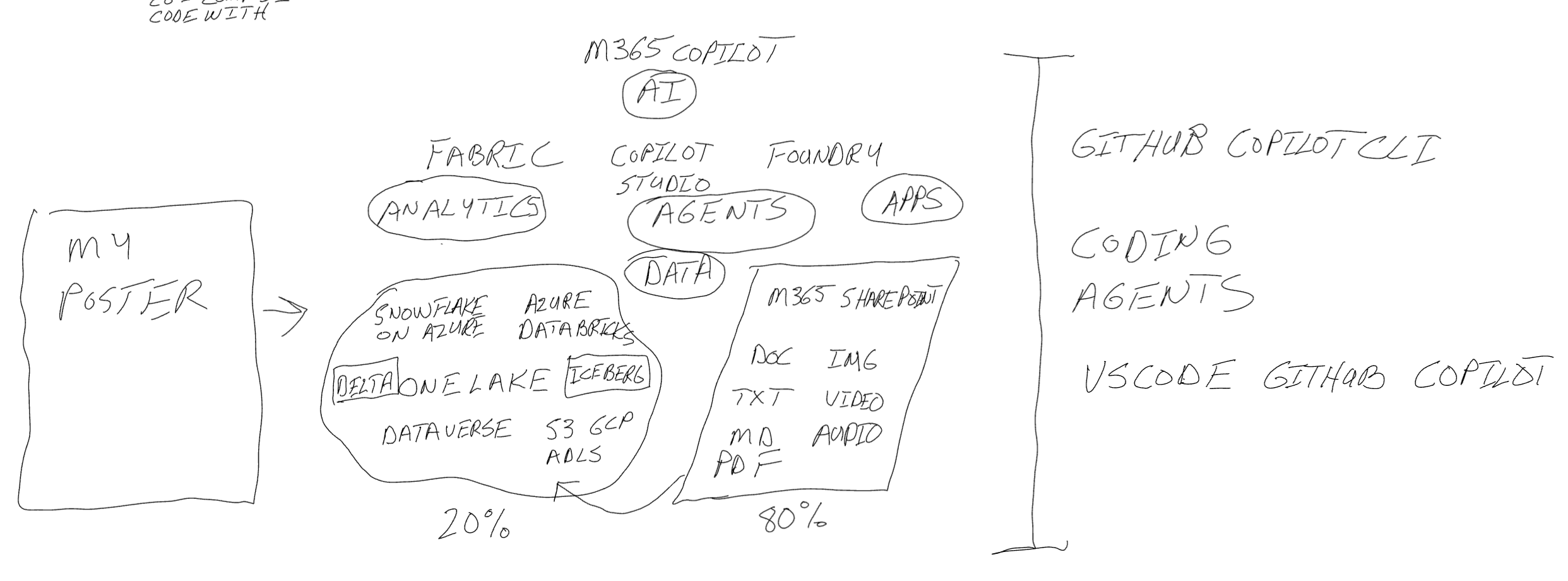
This is the architecture you’re funding. OneLake. Many engines. Open formats as the contract.
Twenty Percent Structured. Eighty Percent Unstructured. Both Are Yours Now.
Most enterprise data architecture spent the last twenty years optimizing the 20% of value that lives in structured systems — ERPs, CRMs, warehouses. The 80% trapped in documents, email, audio, video, images, transcripts, PDFs, and SharePoint sites was someone else’s problem.
That partition is no longer survivable. Agentic AI fails on incomplete context. The boring institutional knowledge that lives in unstructured stores is exactly the fuel that makes agents accurate, grounded, and safe to deploy at scale.
The architecture has converged on a simple answer: lift unstructured data into the same governed estate as structured data, and surface it through the same intelligence layer.
That’s what M365 SharePoint, M365 Copilot, and Foundry deliver alongside Fabric. WorkIQ — the intelligence layer Microsoft 365 Copilot uses to understand your work, your files, your meetings, your style — is the unstructured-data equivalent of what FabricIQ does for structured data with semantic models, joins, and Direct Lake performance. FoundryIQ binds them through AI search and agentic orchestration. Three IQs, one estate, zero context lost between them.
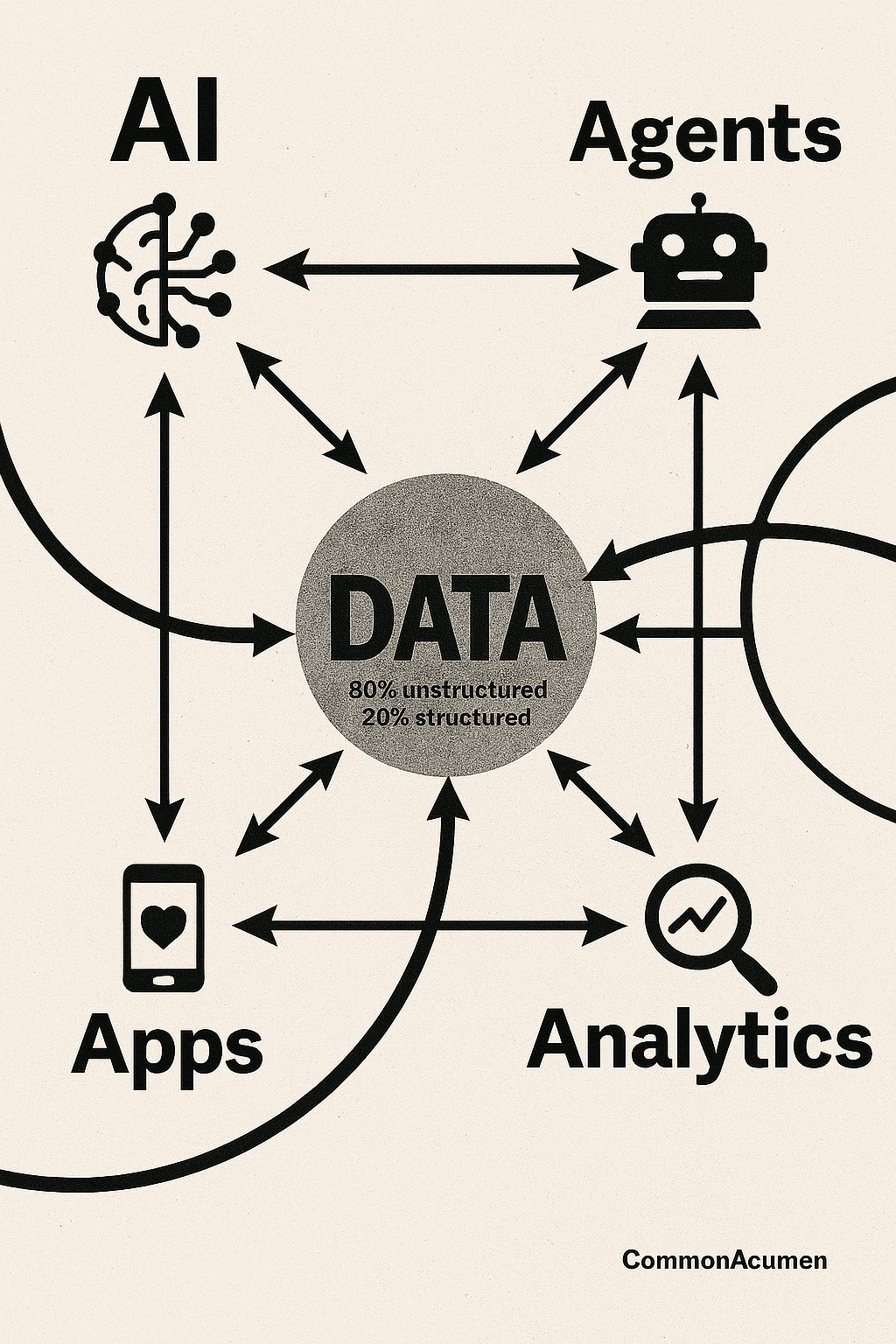
My Poster
The Prosumer Multiplier — and Why It’s Your Most Underpriced Asset
Here is the bet most boards are still under-funding: the Prosumer is the highest-leverage role in the modern enterprise.
A Prosumer is the FP&A analyst who has been quietly building working forecasts in personal Claude or Copilot accounts. The marketing manager piping segments through n8n. The engineer who automated half their team’s release ops with a Zapier flow. The mechanic at a national railroad who wrote a mobile inspection app powered by AI photo analysis — and whose work the railroad’s data scientists are now refining and scaling. (That’s a real Forrester case.)
For decades these people were filed under “shadow IT” and treated as a compliance problem. That framing is now actively destroying enterprise value. When approved tools are provided, unauthorized AI use drops 89%. The demand was never illegitimate. The platform was just missing.
The Frontier Firm move is to legitimize the Prosumer with a governed tier rather than fight them. Microsoft Fabric, Copilot Studio, Power Platform, Agent 365, and the GitHub Copilot / VS Code / Copilot CLI surface together comprise the most complete Prosumer stack any vendor has shipped. When you wire that Prosumer surface into a Databricks- and Snowflake-grade engine room over OneLake, you get the only architecture that satisfies both Prosumer speed and engineer rigor at the same time.
The carrot for the Prosumer: real tools, real compute, real reach into the estate. The standard for the enterprise: open formats, federated governance, audit trails, agent identity, a contribution path back to the catalog. The exchange is the architecture.
Conway’s Law Will Decide This for You — Whether You Like It or Not
Mel Conway noticed in 1968 that systems mirror the communication structures of the organizations that build them. Centralized teams build monoliths. Distributed teams build distributed systems. A central data team cannot — physically cannot — carry the domain context of Finance, Marketing, R&D, Operations, and Risk through one pipe and keep up with a market that’s compounding on AI.
This is not a culture problem. It’s structural physics. The Frontier Firms in your industry are already structured for it.
The architectural answer is Data Mesh: domain ownership, data as a product, self-serve infrastructure, federated governance. Critically, Data Mesh is the only design that explains why a Fabric + Databricks + Snowflake estate is correct rather than confusing — different domains have different personas, different workloads, and different platform fit. The mesh ratifies that. A monolith fights it.
Where the Architecture Has to Be Sharp — and Where Most Decks Wave Their Hands
If you are an architect, this is where the decisions get real. If you are funding the architecture, this is the section to read carefully — these are the four places budget gets wasted when no one owns them.
1. The governance plane. Microsoft Purview and Databricks Unity Catalog do not yet auto-synchronize. A neutral catalog above both — Alation, Collibra, or Purview-as-the-spine with Unity federation — is non-optional. Without it, your mesh becomes a federated set of spreadmarts with credentials. Pick the spine on day one, not year three.
2. The semantic layer as a composable asset, not a finished product. The most expensive architectural mistake of the last decade was treating IT-built Gold tables as the end of the data supply chain. They are the beginning of the Prosumer’s composition. Microsoft Fabric’s decoupled semantic models and composite modeling are explicitly designed for this. Gartner is now warning that 60% of agentic analytics projects relying solely on raw MCP tooling will fail by 2028 due to absence of a consistent semantic layer. Fund the semantic layer like infrastructure, not like a BI deliverable.
3. The orchestration and agent registry. The shift from copilots to agents is the shift from suggestion to action. That requires an agent identity model, runtime guardrails, and a registry of who built which agent and what it’s allowed to do. Microsoft Agent 365, Copilot Studio’s governance plane, and Foundry’s orchestration are converging on this. Your architecture either has an agent registry from day one or it has a security incident in year two.
4. The hybrid posture. Optimism without rigor produces hallucinations at scale. Rigor without optimism produces three-year programs that ship nothing. The honest middle is hybrid — probabilistic AI grounded by deterministic semantic models, governed pipelines, and systems of record. This is the realistic, pragmatic, hybrid stance that actually delivers ROI.
What the Numbers Actually Look Like
The economic argument has gotten cleaner over the last 18 months.
- Frontier Firms are ~4× ahead of slow adopters on brand differentiation, top-line growth, and operating leverage (Microsoft research).
- 89% drop in unauthorized AI use when Prosumers are given sanctioned tools (Vectra AI).
- Mainframe modernization cost dropped from $9.1M (2024) to $7.2M (2025) with ROI more than doubling — driven by AI-accelerated extension and 4 A’s modernization, not rip-and-replace (Network World, Kyndryl).
- 80%+ of AI projects still fail — twice the rate of traditional tech programs — when data foundation, governance, and Prosumer enablement are reversed in sequence (Informatica).
The pattern is unambiguous. Sequence matters. Investing in Prosumer-grade composition surfaces without the unified data estate beneath produces confident hallucinations. Investing in the data estate without the Prosumer composition surface produces beautiful infrastructure no one uses. The Frontier Firms invest in both, in the correct order, and on a single coherent architecture.
What to Fund on Monday
For the architect:
- One governed estate with OneLake as the substrate, Delta and Iceberg as the contract, Fabric/Databricks/Snowflake as personas, M365 SharePoint and Foundry for the unstructured 80%.
- A neutral governance spine — Purview-led with Unity Catalog federation, or a third-party catalog above both. Don’t defer this.
- A composable semantic layer in Fabric that Prosumers can extend without breaking IT contracts. Direct Lake. Composite models. Decoupled semantic items.
- An agent registry under Agent 365 and Copilot Studio governance from day one.
- A Prosumer tier with Copilot Studio, Power Platform, GitHub Copilot CLI, and VS Code wired into the same estate the engineers use — not a separate sandbox that becomes a graveyard.
For the executive:
- Fund the architecture as a single bet, not as five disconnected line items. The compounding only works when the layers connect.
- Fund the Prosumer enablement as deliberately as you fund the platform. This is where the 4× performance gap actually materializes.
- Fund governance and observability as infrastructure, not as a compliance afterthought. Every dollar saved here is paid back at 10× when the program scales.
- Fund change management. Conway’s Law guarantees that the org you have today is the architecture you’ll get tomorrow. Reorganize for distribution and Prosumer participation, not just for committees.
The Bold Bet, Said Plainly
The next decade will divide enterprises into two camps. One camp will keep treating AI as a feature, the data estate as a centralized concern, the Prosumer as a compliance problem, and Fabric vs. Databricks vs. Snowflake as a procurement decision. They will spend a great deal of money building infrastructure that doesn’t compound.
The other camp will fund a single governed estate — Microsoft AI, Fabric, Foundry, M365 SharePoint, M365 Copilot, GitHub Copilot CLI, VS Code, better together with Databricks and Snowflake on OneLake using Delta and Iceberg — designed deliberately so that Prosumers in every domain can compose, contribute, and ship on top of it. They will become Frontier Firms. The 4× gap will become a 10× gap, and then a category-defining one.
The architecture is ready. The economics are clean. The Prosumers are already building. The only remaining question is whether the funding decision matches the ambition of the architecture.
Make the bold bet. The whole stack is finally yours to use.
Companion piece for Prosumers and implementers: see The Prosumer Is the Frontier Firm. Same thesis, different lens.