The Prosumer Is the Frontier Firm
Why Microsoft AI, Fabric, Foundry, M365, and GitHub Copilot CLI — Better Together with Databricks, Snowflake via OneLake, Delta and Iceberg — Finally Give Shadow IT a Home Worth Living In
If you’ve ever waited six months for a report you could have built in an afternoon, you already know what this post is about. You opened Excel anyway. You wired up an Access database, a Notion page, a personal Claude account, an n8n flow, a Zapier hook. You shipped. Then IT found you and called it shadow IT.
You weren’t a problem. You were a signal. And the signal is finally being heard.
The wave we are living through right now — AI, agents, analytics, and new apps stitched across structured and unstructured data — is the biggest legitimization of the Prosumer in fifty years of enterprise computing. Not because the tooling is finally cool enough (it is). Because the architecture has finally caught up with the way work actually happens.
This is a post for the builder who never stopped building.
What a Prosumer Actually Is
Alvin Toffler coined the word in The Third Wave in 1980. The Industrial Revolution split production from consumption. The information age, he argued, would merge them again. He was right — he was just forty years early.
A Prosumer is anyone who co-designs, co-creates, co-curates, co-composes, and codes-with the systems they use. Not a passive recipient of dashboards and pre-baked apps. A participant. Someone with deep domain knowledge, technical curiosity, and a relentless bias toward outcomes.
Every wave of enterprise tech has produced them. Lotus 1-2-3 in the 80s. Access datamarts in the 90s. SaaS in the 2000s. Power BI and Tableau in the 2010s. Each time, the same five motivations: IT was too slow, the functional need was unmet, a better tool existed outside the perimeter, the Prosumer’s domain knowledge was an unfair advantage, and the deadline was real.
The pattern resolved the same way every time too — not by banning the Prosumer, but by building a new tier of the platform that absorbed their energy into the governed estate. Excel got SharePoint and Power BI. Access got Power Platform. Shadow SaaS got SSO and CASB. Each generation took roughly a decade.
This generation is faster, and the stakes are higher. Because this time, the Prosumer isn’t shipping a static spreadsheet. They’re using Coding Agents like GitHub Copilot CLI and Claude Code and shipping autonomous agents. These Coding Agents are more enabling, addictive, and make the Prosumer more productive than ever. You can’t be technically blocked.
Shadow IT Was Never the Disease. It Was the Diagnosis.
For decades, IT departments tried to stomp out shadow IT. Data Mesh and the modern AI stack do the opposite. They give it a home.
The deal is straightforward, and it’s a good one:
The carrot: You get the heavy-duty platform you always wanted. Microsoft Fabric for analytics and semantic models. M365 SharePoint for the 80% of your data that’s documents, email, audio, video, images. M365 Copilot as the user surface that already lives where you work. GitHub Copilot CLI and VS Code so you can code-with instead of code-around. Foundry for AI search, agents, and orchestration. OneLake underneath, with Databricks and Snowflake right there inside it — same Delta tables, same Iceberg tables, no copy, no re-engineering.
The standard: You publish to the mesh in open formats. You follow the security and governance posture. You let your work be discoverable, attributable, reusable. In exchange, your output stops being a brittle macro that breaks the day you leave and becomes a real data product with an audit trail and an SLO.
That trade — that’s the formalization of shadow IT. That’s what turns chaos into scale.
Why “Better Together” Is the Only Architecture That Survives Contact With Reality
Pick a single platform and you’ve already lost. The Finance Prosumer wants Excel-grade familiarity, Power Query lineage, and a Power BI surface that talks to M365 Copilot. The ML engineer wants Databricks notebooks, Mosaic AI, MLflow, and PySpark. The analytics engineer wants Snowflake’s zero-admin SQL warehouse and clean data sharing. The compliance team wants Purview and Unity Catalog, because neither of them speaks the other’s dialect yet.
The mistake isn’t picking three platforms. The mistake is treating them as competitors. They’re not. They’re personas.
OneLake plus open table formats is what makes the détente real. When Finance publishes a Gold table as Delta or Iceberg in OneLake, the ML team in Databricks reads it without copying. When Snowflake reads OneLake-backed Iceberg tables, the data sharing story is one estate, not three. The 80% of value that lives in unstructured M365 SharePoint content gets lifted into the same mesh by Foundry’s AI search and Fabric’s semantic models. M365 Copilot composes across all of it.
Twenty percent structured. Eighty percent unstructured. OneLake. Many engines. That’s the picture.
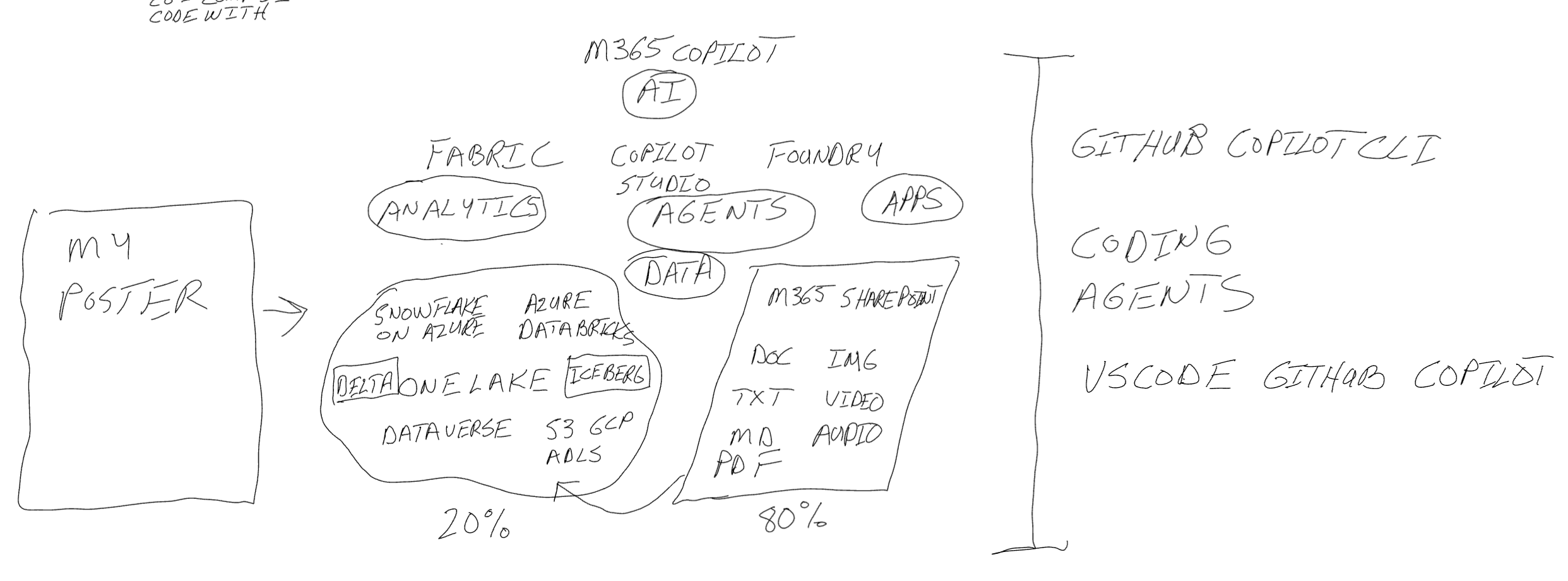
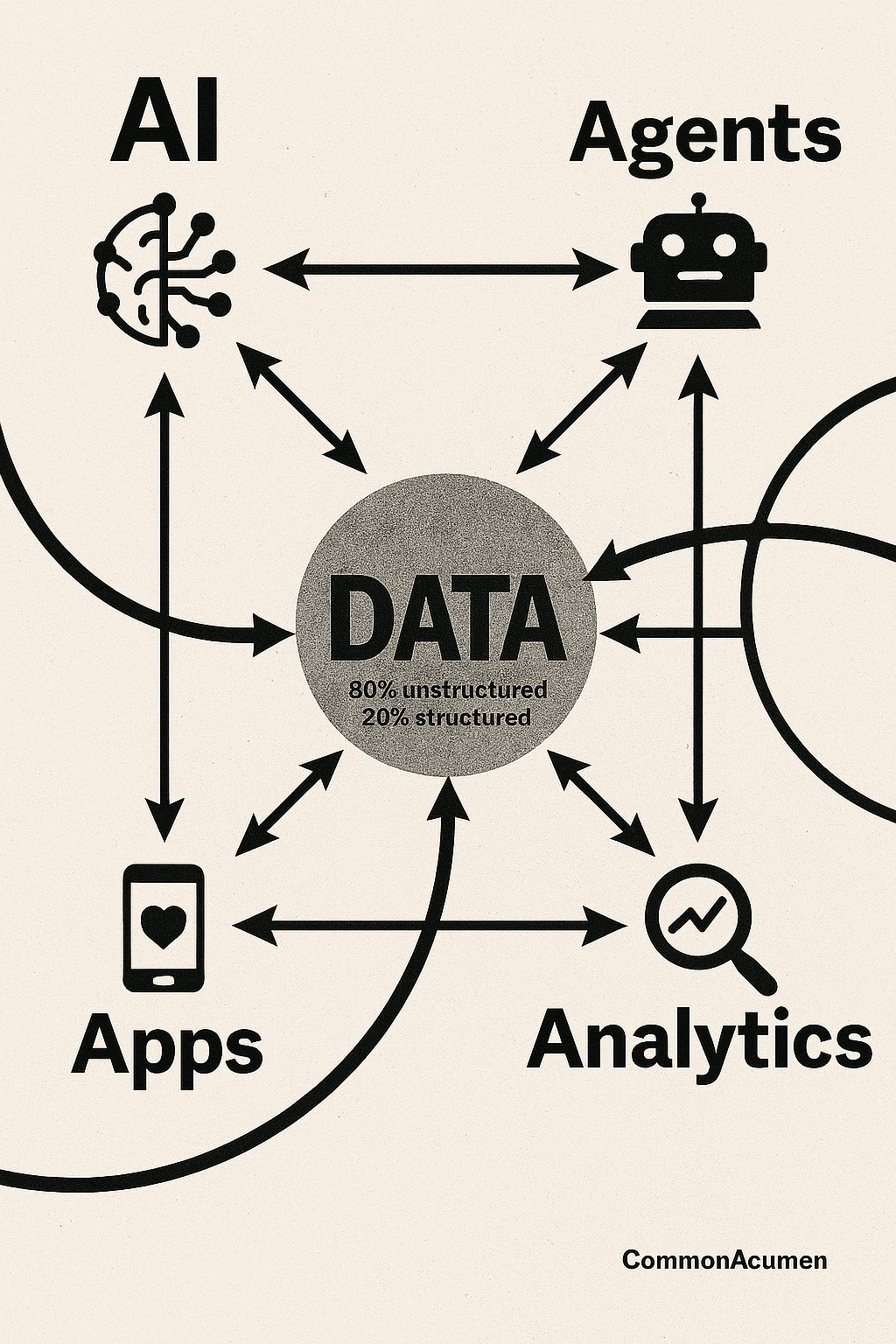
My Poster
Conway’s Law Is Doing the Heavy Lifting
Mel Conway noticed in 1968 that systems mirror the communication structures of the organizations that build them. Centralized teams build centralized monoliths. Distributed teams build distributed systems. You can’t outrun your own org chart with architecture diagrams.
This is why a centralized, IT-only data warehouse always loses to a Data Mesh once the organization gets past a certain size. You cannot compress the domain knowledge of Finance, Marketing, R&D, Operations, and Risk through one central pipe and expect to keep up with the business. Conway’s Law won’t let you.
Distribution isn’t a fashion. It’s a structural requirement for speed.
The Data Mesh principles fall straight out of Conway’s Law: domain ownership, data as a product, self-serve infrastructure, federated governance. You’re not adopting Data Mesh because it’s trendy. You’re adopting it because your competitors who already adopted it ship four times faster than you do, and Microsoft’s own Frontier Firm research says fast adopters are pulling away from slow adopters on brand differentiation, top-line growth, and operating leverage simultaneously.
The Frontier Firm Is a Prosumer rich Firm
The phrase “Frontier Firm” gets thrown around in a lot of decks. Strip the marketing off and what it actually means is this: an organization that treats intelligence as a utility, agents as colleagues, and Prosumers as the engine of innovation rather than a compliance problem.
Frontier Firms don’t lock the Prosumer out. They give them:
- A composition layer — natural language agent assembly in Copilot Studio, low-code in Power Platform, real code in VS Code with GitHub Copilot, GitHub Copilot CLI for the terminal-bound builder, Foundry for the orchestrated agent.
- A unification layer — OneLake, M365 SharePoint, semantic models in Fabric, knowledge stores in Foundry, Delta and Iceberg as the open contracts that let Databricks and Snowflake play in the same mesh.
- An orchestration layer — agents that can chain across structured and unstructured data, write back to systems of record, and escalate to a human when stakes are high.
- A contribution path — a way for what a Prosumer composes on Tuesday to be peer-reviewed, hardened, and promoted to the catalog by Friday. The railroad mechanic’s photo-inspection app becomes a real product, not a compliance incident.
The IT-built Gold table is no longer the end of the data supply chain. It’s the beginning of the Prosumer’s composition. That single inversion is what unlocks the rest.
The Realistic Bet: Hybrid
Every honest assessment of AI right now lands in the same place. Pure optimism is naive. Pure pessimism is paralysis. Realistic is the line between them. Pure idealism is a deck. Pragmatism is what ships. Pure non-determinism is a chatbot. Pure determinism is a 1990s rules engine. Hybrid — probabilistic AI grounded by deterministic semantics, governance, and systems of record — is what actually works.
That hybrid posture is exactly what Microsoft AI plus Fabric plus Foundry plus M365 — better together with Databricks and Snowflake on OneLake, in Delta and Iceberg — actually delivers. Probabilistic agents over governed semantic layers. Vibe-working over real systems of record. Optimism with audit trails.
So What Are You Supposed To Do On Monday
If you’re a Prosumer reading this, the work is concrete and it’s available right now.
Pick a real problem you’ve already been solving in shadow. A spreadsheet, a personal Claude or Copilot account, a half-built workflow in n8n. That’s your first data product candidate. Don’t reinvent it. Re-host it.
Land it in the mesh. Publish your structured output as a Delta or Iceberg table in OneLake. Land your unstructured content in M365 SharePoint with Foundry-grade indexing. Compose the surface in M365 Copilot, or in a Copilot Studio agent, or in a VS Code workspace with GitHub Copilot CLI riding along.
Wire in the better-together pieces deliberately. If your domain needs ML, point Databricks at the OneLake table — no copy. If your domain needs warehouse-grade SQL or external data sharing, point Snowflake at the same Iceberg table — no copy. The era of triplicate data is over.
Claim governance instead of dodging it. Register your agent. Accept the audit trail. The point of a sanctioned tier isn’t to slow you down — it’s to let you go faster without the next reorg deleting your work.
Tom Sawyer the next person. The fastest way to scale a Frontier Firm is to multiply Prosumers. Show one colleague how you composed your last endpoint. Then two. The breadth of what any individual can do, multiplied by the breadth of who’s doing it, is the real productivity curve.
The Bold Part
Here is the bold claim, said plainly: the future of the enterprise is not better central IT. It is more, better, governed Prosumers.
Darwin’s Theory: The companies that get this — that wire Microsoft AI, Fabric, Foundry, M365 SharePoint, M365 Copilot, GitHub Copilot CLI and VS Code together with Databricks and Snowflake on OneLake using Delta and Iceberg — aren’t going to be 20% more productive than their competitors. They’re going to be a different category of organism. Distributed, agile, agent-augmented, Prosumer-powered. Frontier Firms.
Conway’s Law guarantees it. Toffler predicted it forty years ago. Every wave of shadow IT in the last fifty years rehearsed it. The platform is finally ready.
You were never the problem. You were the prototype.
Now build.
Built from 33 years of experience and notes and conversations across customer engagements, plus too many late-night threads to count. Co-designed, co-created, co-curated, co-composed, code-with.